How Should I Study
the Bible?
By Bishop Kallistos Ware: How to Read the Bible
WE
BELIEVE THAT THE SCRIPTURES constitute a coherent whole. They are
at once divinely inspired and humanly expressed. They bear authoritative
witness to God's revelation of Himself - in creation, in the Incarnation
of the Word, and the whole history of salvation. And as such they
express the word of God in human language. We know, receive, and
interpret Scripture through the Church and in the Church. Our approach
to the Bible is one of obedience.
We may distinguish four key qualities that
mark an Orthodox reading of Scripture, namely:
1. It should be obedient,
2. It should be ecclesial, within the Church,
3. It should be Christ-centered,
4. It should be personal.
Reading the Bible
with Obedience
FIRST OF ALL, when reading Scripture, we are to listen in a spirit
of obedience. The Orthodox Church believes in divine inspiration
of the Bible. Scripture is a "letter" from God, where Christ
Himself is speaking. The Scriptures are God's authoritative witness
of Himself. They express the Word of God in our human language. Since
God Himself is speaking to us in the Bible, our response is rightly
one of obedience, of receptivity, and listening. As we read, we wait
on the Spirit.
But, while divinely inspired, the Bible is also humanly expressed.
It is a whole library of different books written at varying times
by distinct persons. Each book of the Bible reflects the outlook
of the age in which it was written and the particular viewpoint of
the author. For God does nothing in isolation, divine grace cooperates
with human freedom. God does not abolish our individuality but enhances
it. And so it is in the writing of inspired Scripture. The authors
were not just a passive instrument, a dictation machine recording
a message. Each writer of Scripture contributes his particular personal
gifts. Alongside the divine aspect, there is also a human element
in Scripture. We are to value both.
Each of the four Gospels, for example, has
its own particular approach. Matthew presents more particularly a
Jewish understanding of Christ, with an emphasis on the kingdom of
heaven. Mark contains specific, picturesque details of Christ's ministry
not given elsewhere. Luke expresses the universality of Christ's
love, His all-embracing compassion that extends equally to Jew and
to Gentile. In John there is a more inward and more mystical approach
to Christ, with an emphasis on divine light and divine indwelling.
We are to enjoy and explore to the full this life-giving variety
within the Bible.
Because Scripture is in this way the word
of God expressed in human language, there is room for honest and
exacting inquiry when studying the Bible. Exploring the human aspect
of the Bible, we are to use to the full our God-given human reason.
The Orthodox Church does not exclude scholarly research into the
origin, dates, and authorship of books of the Bible.
Alongside this human element, however, we
see always the divine element. These are not simply books written
by individual human writers. We hear in Scripture not just human
words, marked by a greater or lesser skill and perceptiveness, but
the eternal, uncreated Word of God Himself, the divine Word of salvation.
When we come to the Bible, then, we come not simply out of curiosity,
to gain information. We come to the Bible with a specific question,
a personal question about ourselves: "How can I be saved?"
As God's divine word of salvation in human
language, Scripture should evoke in us a sense of wonder. Do you
ever feel, as you read or listen, that it has all become too familiar?
Has the Bible grown rather boring? Continually we need to cleanse
the doors of our perception and to look in amazement with new eyes
at what the Lord sets before us.
We are to feel toward the Bible with a sense
of wonder, and sense of expectation and surprise. There are so many
rooms in Scripture that we have yet to enter. There is so much depth
and majesty for us to discover. If obedience means wonder, it also
means listening.
We are better at talking than listening. We
hear the sound of our own voice, but often we don't pause to hear
the voice of the other person who is speaking to us. So the first
requirement, as we read Scripture, is to stop talking and to listen
- to listen with obedience.
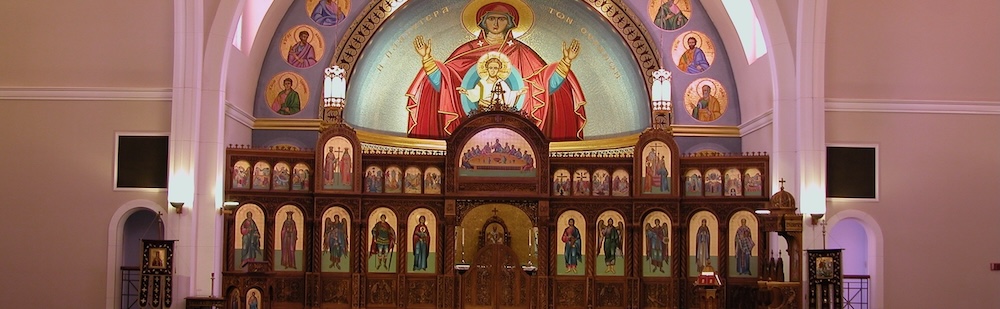
When we enter an Orthodox Church, decorated
in the traditional manner, and look up toward the sanctuary at the
east end, we see there, in the apse, an icon of the Virgin Mary with
her hands raised to heaven - the ancient Scriptural manner of praying
that many still use today. This icon symbolizes the attitude we are
to assume as we read Scripture - an attitude of receptivity, of hands
invisibly raised to heaven. Reading the Bible, we are to model ourselves
on the Blessed Virgin Mary, for she is supremely the one who listens.
At the Annunciation she listens with obedience and responds to the
angel, "Be it unto me according to thy word" (Luke 1:38).
She could not have borne the Word of God in her body if she had not
first, listened to the Word of God in her heart. After the shepherds
have adored the newborn Christ, it is said of her: "Mary kept
all these things and pondered them in her heart" (Luke 2:19).
Again, when Mary finds Jesus in the temple, we are told: "His
mother kept all these things in her heart" (Luke 2:5l). The
same need for listening is emphasized in the last words attributed
to the Mother of God in Scripture, at the wedding feast in Cana of
Galilee: "Whatsoever He saith unto you, do it" (John 2:5),
she says to the servants - and to all of us.
In all this the Blessed Virgin Mary serves
as a mirror, as a living icon of the Biblical Christian. We are to
be like her as we hear the Word of God: pondering, keeping all these
things in our hearts, doing whatever He tells us. We are to listen
in obedience as God speaks.
Understanding the
Bible Through the Church
IN THE SECOND PLACE, we should receive and interpret Scripture through
the Church and in the Church. Our approach to the Bible is not only
obedient but ecclesial.
It is the Church that tells us what is Scripture.
A book is not part of Scripture because of any particular theory
about its dating and authorship. Even if it could be proved, for
example, that the Fourth Gospel was not actually written by John
the beloved disciple of Christ, this would not alter the fact that
we Orthodox accept the Fourth Gospel as Holy Scripture. Why? Because
the Gospel of John is accepted by the Church and in the Church.
It is the Church that tells us what is Scripture,
and it is also the Church that tells us how Scripture is to be understood.
Coming upon the Ethiopian as he read the Old Testament in his chariot,
Philip the Apostle asked him, "Understandest thou what thou
readest?" And the Ethiopian answered, "How can I, unless
some man should guide me?" (Acts 8:30-31). We are all in the
position of the Ethiopian. The words of Scripture are not always
self-explanatory. God speaks directly to the heart of each one of
us as we read our Bible. Scripture reading is a personal dialogue
between each one of us and Christ - but we also need guidance. And
our guide is the Church. We make full use of our own personal understanding,
assisted by the Spirit, we make full use of the findings of modern
Biblical research, but always we submit private opinion - whether
our own or that of the scholars - to the total experience of the
Church throughout the ages.
The Orthodox standpoint here is summed up
in the question asked of a convert at the reception service used
by the Russian Church: "Do you acknowledge that the Holy Scripture
must be accepted and interpreted in accordance with the belief which
has been handed down by the Holy Fathers, and which the Holy Orthodox
Church, our Mother, has always held and still does hold?"
We read the Bible personally, but not as isolated
individuals. We read as the members of a family, the family of the
Orthodox Catholic Church. When reading Scripture, we say not " I" but "We." We
read in communion with all the other members of the Body of Christ,
in all parts of the world and in all generations of time. The decisive
test and criterion for our understanding of what the Scripture means
is the mind of the Church. The Bible is the book of the Church.
To discover this "mind of the Church," where
do we begin? Our first step is to see how Scripture is used in worship.
How, in particular, are Biblical lessons chosen for reading at the
different feasts? We should also consult the writings of the Church
Fathers, and consider how they interpret the Bible. Our Orthodox
manner of reading Scripture is in this way both liturgical and patristic.
And this, as we all realize, is far from easy to do in practice,
because we have at our disposal so few Orthodox commentaries on Scripture
available in English, and most of the Western commentaries do not
employ this liturgical and Patristic approach.
As an example of what it means to interpret
Scripture in a liturgical way, guided by the use made of it at Church
feasts, let us look at the Old Testament lessons appointed for Vespers
on the Feast of the Annunciation. They are three in number: Genesis
28:10-17; Jacob's dream of a ladder set up from earth to heaven;
Ezekiel 43:27-44:4; the prophet's vision of the Jerusalem sanctuary,
with the closed gate through which none but the Prince may pass;
Proverbs 9:1-11: one of the great Sophianic passages in the Old Testament,
beginning "Wisdom has built her house."
These texts in the Old Testament, then, as
their selection for the feast of the Virgin Mary indicates, are all
to be understood as prophecies concerning the Incarnation from the
Virgin. Mary is Jacob's ladder, supplying the flesh that God incarnate
takes upon entering our human world. Mary is the closed gate who
alone among women bore a child while still remaining inviolate. Mary
provides the house which Christ the Wisdom of God (1 Cor. 1:24) takes
as his dwelling. Exploring in this manner the choice of lessons for
the various feasts, we discover layers of Biblical interpretation
that are by no means obvious on a first reading.
Take as another example Vespers on Holy Saturday,
the first part of the ancient Paschal Vigil. Here we have no less
than fifteen Old Testament lessons. This sequence of lessons sets
before us the whole scheme of sacred history, while at the same time
underlining the deeper meaning of Christ's Resurrection. First among
the lessons is Genesis 1:1-13, the account of Creation: Christ's
Resurrection is a new Creation. The fourth lesson is the book of
Jonah in its entirety, with the prophet's three days in the belly
of the whale foreshadowing Christ's Resurrection after three days
in the tomb (cf. Matthew 12:40). The sixth lesson recounts the crossing
of the Red Sea by the Israelites (Exodus 13:20-15:19), which anticipates
the new Passover of Pascha whereby Christ passes over from death
to life (cf. 1 Corinthians 5:7; 10:1-4). The final lesson is the
story of the three Holy Children in the fiery furnace (Daniel 3),
once more a "type" or prophecy of Christ's rising from
the tomb.
Such is the effect of reading Scripture ecclesially,
in the Church and with the Church. Studying the Old Testament in
this liturgical way and using the Fathers to help us, everywhere
we uncover signposts pointing forward to the mystery of Christ and
of His Mother. Reading the Old Testament in the light of the New,
and the New in the light of the, Old - as the Church's calendar encourages
us to do - we discover the unity of Holy Scripture. One of the best
ways of identifying correspondences between the Old and New Testaments
is to use a good Biblical concordance. This can often tell us more
about the meaning of Scripture than any commentary.
In Bible study groups within our parishes,
it is helpful to give one person the special task of noting whenever
a particular passage in the Old or New Testament is used for a festival
or a saint's day. We can then discuss together the reasons why each
specific passage has been so chosen. Others in the group can be assigned
to do homework among the Fathers, using for example the Biblical
homilies of Saint John Chrysostom (which have been translated into
English). Christians need to acquire a patristic mind.
Christ, the Heart
of the Bible
THE THIRD ELEMENT in our reading of Scripture is that it should be
Christ-centered. The Scriptures constitute a coherent whole because
they all are Christ-centered. Salvation through the Messiah is their
central and unifying topic. He is as a "thread" that runs
through all of Holy Scripture, from the first sentence to the last.
We have already mentioned the way in which Christ may be seen foreshadowed
on the pages of the Old Testament.
Much modern critical study of Scripture in
the West has adopted an analytical approach, breaking up each book
into different sources. The connecting links are unraveled, and the
Bible is reduced to a series of bare primary units. There is certainly
value in this. But we need to see the unity as well as the diversity
of Scripture, the all-embracing end as well as the scattered beginnings.
Orthodoxy prefers on the whole a synthetic rather than an analytical
approach, seeing Scripture as an integrated whole, with Christ everywhere
as the bond of union.
Always we seek for the point of convergence
between the Old Testament and the New, and this we find in Jesus
Christ. Orthodoxy assigns particular significance to the "typological" method
of interpretation, whereby "types" of Christ, signs and
symbols of His work, are discerned throughout the Old Testament.
A notable example of this is Melchizedek, the priest-king of Salem,
who offered bread and wine to Abraham (Genesis 14:18), and who is
seen as a type of Christ not only by the Fathers but even in the
New Testament itself (Hebrews 5:6; 7:l). Another instance is the
way in which, as we have seen, the Old Passover foreshadows the New;
Israel's deliverance from Pharaoh at the Red Sea anticipates our
deliverance from sin through the death and Resurrection of the Savior.
This is the method of interpretation that we are to apply throughout
the Bible. Why, for instance, in the second half of Lent are the
Old Testament readings from Genesis dominated by the figure of Joseph?
Why in Holy Week do we read from the book of Job? Because Joseph
and Job are innocent sufferers, and as such they are types or foreshadowings
of Jesus Christ, whose innocent suffering upon the Cross the Church
is at the point of celebrating. It all ties up.
A Biblical Christian is the one who, wherever
he looks, on every page of Scripture, finds everywhere Christ.
The Bible as Personal
IN THE WORDS of an early ascetic writer in the Christian East, Saint
Mark the Monk: "He who is humble in his thoughts and engaged
in spiritual work, when he reads the Holy Scriptures, will apply
everything to himself and not to his neighbor." As Orthodox
Christians we are to look everywhere in Scripture for a personal
application. We are to ask not just "What does it mean?" but "What
does it mean to me?" Scripture is a personal dialogue between
the Savior and myself - Christ speaking to me, and me answering.
That is the fourth criterion in our Bible reading.
I am to see all the stories in Scripture as
part of my own personal story. Who is Adam? The name Adam means "man," "human," and
so the Genesis account of Adam's fall is also a story about me. I
am Adam. It is to me that God speaks when He says to Adam, "Where
art thou?" (Genesis 3:9). "Where is God?" we often
ask. But the real question is what God asks the Adam in each of us: "Where
art thou?"
When, in the story of Cain and Abel, we read God's words to Cain, "Where
is Abel thy brother?" (Genesis 4:9), these words, too, are addressed
to each of us. Who is Cain? It is myself. And God asks the Cain in
each of us, "Where is thy brother?" The way to God lies
through love of other people, and there is no other way. Disowning
my brother, I replace the image of God with the mark of Cain, and
deny my own vital humanity.
In reading Scripture, we may take three steps.
First, what we have in Scripture is sacred history: the history of
the world from the Creation, the history of the chosen people, the
history of God Incarnate in Palestine, and the "mighty works" after
Pentecost. The Christianity that we find in the Bible is not an ideology,
not a philosophical theory, but a historical faith.
Then we are to take a second step. The history
presented in the Bible is a personal history. We see God intervening
at specific times and in specific places, as He enters into dialogue
with individual persons. He addresses each one by name. We see set
before us the specific calls issued by God to Abraham, Moses and
David, to Rebekah and Ruth, to Isaiah and the prophets, and then
to Mary and the Apostles. We see the selectivity of the divine action
in history, not as a scandal but as a blessing. God's love is universal
in scope, but He chooses to become Incarnate in a particular comer
of the earth, at a particular time and from a particular Mother.
We are in this manner to savor all the uniqueness of God's action
as recorded in Scripture. The person who loves the Bible loves details
of dating and geography. Orthodoxy has an intense devotion to the
Holy Land, to the exact places where Christ lived and taught, died
and rose again. An excellent way to enter more deeply into our Scripture
reading is to undertake a pilgrimage to Jerusalem and Galilee. Walk
where Christ walked. Go down to the Dead Sea, sit alone on the rocks,
feel how Christ felt during the forty days of His temptation in the
wilderness. Drink from the well where He spoke with the Samaritan
woman. Go at night to the Garden of Gethsemane, sit in the dark under
the ancient olives and look across the valley to the lights of the
city. Experience to the full the reality of the historical setting,
and take that experience back with you to your daily Scripture reading.
Then we are to take a third step. Reliving
Biblical history in all its particularity, we are to apply it directly
to ourselves. We are to say to ourselves, "All these places
and events are not just far away and long ago, but are also part
of my own personal encounter with Christ. The stories include me."
Betrayal, for example, is part of the personal
story of everyone. Have we not all betrayed others at some time in
our life, and have we not all known what it is to be betrayed, and
does not the memory of these moments leave continuing scars on our
psyche? Reading, then, the account of Saint Peter's betrayal of Christ
and of his restoration after the Resurrection, we can see ourselves
as actors in the story. Imagining what both Peter and Jesus must
have experienced at the moment immediately after the betrayal, we
enter into their feelings and make them our own. I am Peter; in this
situation can I also be Christ? Reflecting likewise on the process
of reconciliation - seeing how the Risen Christ with a love utterly
devoid of sentimentality restored the fallen Peter to fellowship,
seeing how Peter on his side had the courage to accept this restoration
- we ask ourselves: How Christ-like am I to those who have betrayed
me? And, after my own acts of betrayal, am I able to accept the forgiveness
of others - am I able to forgive myself? Or am I timid, mean, holding
myself back, never ready to give myself fully to anything, either
good or bad? As the Desert Fathers say, "Better someone who
has sinned, if he knows he has sinned and repents, than a person
who has not sinned and thinks of himself as righteous."